Green Way Energy

Green Way Energy
Bringing EV best practices home — from the source
Williams worked during 2018 with energy consultants John Flory from eSmart Systems, a provider of AI-powered infrastructure solutions, and Paul Jensen from Green Way Energy which helps companies develop clean transportation strategies, to find out how feasible it was to invest in EV charging in a place where temperatures regularly average below freezing during the winter. Flory observed that Norway is No. 1 in electric vehicles per capita in the world, so eSmart organized a “smart innovations learning tour” of the country. “We don't know what we don't know, but we do know what's been successful,” Williams says. “We always hear that you can't have EVs in cold weather, so we wanted to go to Norway.
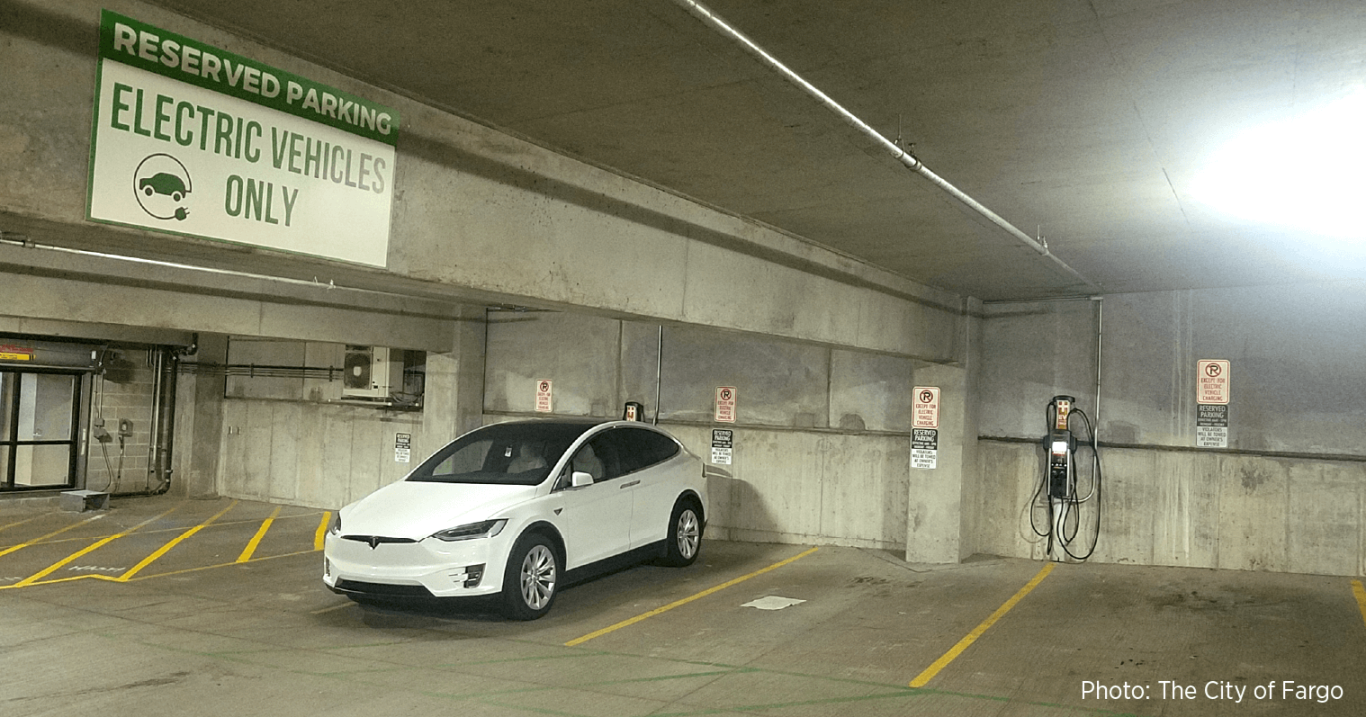
In 2018, he traveled to Norway along with Flory and Jensen as well as Terry Sando, the mayor of Hillsboro, North Dakota, and 12 others. The first stop was a mixed-use parking ramp that had a hundred EV chargers. According to Flory, the trip laid the groundwork for a pilot project supported by the State of North Dakota. The project brings solar power and EV charging to the recently completed seven-story, state-of-the-art, 458-stall parking facility in downtown Fargo called Roberts Commons Garage (RoCo ramp for short). The garage is surrounded on three sides by mixed use residential, retail and dining.
Along with reducing emissions, we need to help get people where they need to go for less, and in a cleaner way. Electric vehicles are a good way to do that, and we want to help pave the way for that transition. — Mike Williams, Parking Commissioner, City of Fargo
Harnessing the power of the sun — and adding value
Flory now works for risk management firm The Alliance Risk Group and runs the pilot project for the state. “Initially, we were going to have the 48 solar panels deliver power to some stand-alone EV chargers. Paul Jensen convinced us to install five intelligent dual-port ChargePoint Level 2 EV charging stations at RoCo ramp instead,” Flory says.
Solar not only provides energy, but it also helps the city avoid peak utility demand charges. Three 15kW smart lithium-ion batteries store that solar power to further cut emissions and costs. “In Fargo, a lot of times, we aren’t the earliest adopters,” Williams says. “We sometimes call it ‘the leapfrog effect’ because we like to sit back and see what’s working, maybe add a little bit of value, and then implement something that best applies to us.”
In Fargo, a lot of times we aren’t the earliest adopters. We sometimes call it ‘the leapfrog effect’ because we like to sit back and see what’s working, maybe add a little bit of value, and then implement something that best applies to us. — Mike Williams, Parking Commissioner, City of Fargo
Norway wasn't the only country Williams’ team looked at for inspiration. “Germany is the largest solar producer per capita by far, and we have a better solar resource than Germany — the sun shines quite a bit here — and so solar is feasible,” he says. In fact, Fargo boasts 200 sunny days per year on average, compared with 158 for Germany.
Making transportation easier — and cleaner
“What we found in Go2030 is that our residents spend more on transportation on average — on their cars, parking and everything else — than they do on housing. It’s the opposite of what happens in a place like San Francisco,” Williams says. “So, along with reducing emissions, we need to help get people where they need to go for less, and in a cleaner way. Electric vehicles are a good way to do that, and we want to help pave the way for that transition.” With 20,000 people working in the downtown area and another 5,000–6,000 living there, there wasn’t any room for error when choosing an electric fueling partner.
I spoke to some folks in Minneapolis-St. Paul, and they really liked working with ChargePoint and were happy with the support. It was obvious that people were familiar with ChargePoint. When someone buys an electric vehicle, a lot of times they'll already have a ChargePoint card. — Mike Williams, Parking Commissioner, City of Fargo
Why ChargePoint?
ChargePoint’s sophisticated reporting features and intelligent software were a crucial component of pulling off such an ambitious plan focused on smart energy use, Williams says. Brand reputation and recognition were important as well. “I spoke to some folks in Minneapolis-St. Paul, and they really liked working with ChargePoint and were happy with the support. It was obvious that people were familiar with ChargePoint. When someone buys an electric vehicle, a lot of times they'll already have a ChargePoint card.” As of this writing, Fargo was in the process of installing a ChargePoint DC fast charger in front of city hall. “We'll have our first fast charging station three blocks from where we have our 10 ports at the Roberts Commons,” Williams says, noting that, when it comes to sustainability, Fargo is just getting started.
In part two of our North Dakota series, we head to one of the state’s smallest towns, Hillsboro, to find out how ChargePoint is impacting the community there. In part three, it’s off to the state capital, Bismarck, to conclude our trilogy on one of our favorite states to charge.
What comes to mind when you think of North Dakota? For folks who haven’t yet had the pleasure of visiting, it might be cold winters with plenty of snow, affable residents with a quirky dialect or the 1996 Coen Brothers’ film “Fargo.” What people don’t usually think of is technological innovation, vibrant communities and plenty of sunshine. Sunshine? Yes, and these elements are all coming together to revitalize communities, attract young tech workers and power electric vehicles somewhere you’d least expect it. Speaking of Fargo, in this first of a three-part series on the burgeoning electric vehicle (EV) scene in North Dakota, we travel from the state’s largest city to Norway and back again.
In 2010, the city of Fargo put out an RFP for a comprehensive plan asking people, “What kind of city do you want Fargo to be by 2030?” According to the city’s current parking commissioner and former deputy mayor, Mike Williams, “We got 8,700 responses. If an idea was good, others would second it, and the best ideas rose to the top. In the top 10 were renewable energy and conservation.”
Based in part on that poll, city leaders set about implementing the Go2030 sustainability plan, which includes remaking Fargo by revitalizing the downtown core and implementing an ambitious goal of achieving carbon neutrality by 2030. “A lot of people realized that emissions from transportation was one of the biggest causes of greenhouse gas (GHG) emissions, and electric vehicles can help with that. Developing EV infrastructure and paving the way for electric cars was identified as a key initiative by our residents back in 2010,” Williams says. “And it’s been our mission to try to achieve that goal.”
In the first installment of our three-part series on electric vehicle (EV) charging in North Dakota, we traveled to the state’s largest city, Fargo. This time, we visit a slightly less populous place to discover why, in this changing era of transportation, some of the biggest ideas are coming from the smallest places. Hillsboro, a farming community located in the eastern part of the state between Grand Forks and Fargo on Interstate 29, is home to just 1,644 residents as of the last census. What it lacks in size, however, the town is making up for in innovative ideas.
“I'm the president of the city commission, but everybody calls me mayor,” says Terry Sando, who is in his third year of a four-year term. Although he’s lived in Hillsboro for nearly a decade, locals still consider him a newcomer, he says. But being an outsider has its advantages — especially when it comes to outside-of-the-box solutions to old problems and fresh ideas for future economic development.
For example, since beginning his tenure in 2018, Sando has championed Riverwalk Development, a 128-acre community that, when complete, will include 43 residential and six commercial lots, 10 town homes, more than two miles of walking paths and trails, and 10-acres of parks designed to attract new residents and spur economic development in Hillsboro. For Sando, however, planning for a prosperous tomorrow doesn’t stop with housing future residents — it extends to fueling their next cars as well

We see [EV charging] as a big opportunity for the city of Hillsboro to really grow. It also helps us to be a destination for some of those Canadian and U.S. visitors who want to get off of I-29. — Terry Sando, President of the City Commission, Hillsboro, North Dakota
In the right place at the right time
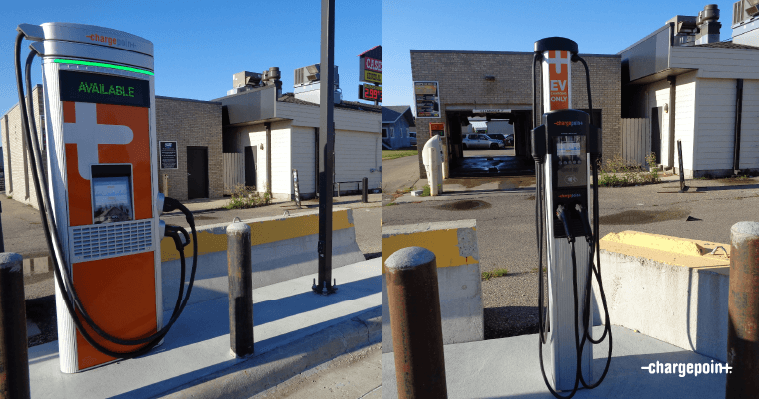
Realizing his town is also optimal charging distance for electric vehicle drivers traveling from Winnipeg to Minneapolis and vice versa, Sando was instrumental in bringing EV charging to the town. The charging stations, a ChargePoint dual-port Express Plus DC fast charger and a dual-port CT4000 Level 2 AC station, are prominently located in Hillsboro’s city center, right outside the town’s sole Subway restaurant. It’s a gathering place for locals during North Dakota’s long winter months — or “meeting season” as it’s colloquially known — and, Sando predicts, a boon for future economic development in the area. “We see it as a big opportunity for the city of Hillsboro to really grow,” he says. “It also helps us to be a destination for some of those Canadian and U.S. visitors who want to get off of I-29.”
From fleets to farmers, everyone benefits from EV charging
It’s not only visitors who will benefit from having EV charging in Hillsboro, Sando says. Electric delivery fleets will be able to take advantage of the fast charging too. He believes local farmers, many of whom are currently skeptical of the new technology, will also come around to EVs for purely practical reasons. “We think it will be something our agricultural community around Hillsboro will start to take a look at because of the simplicity of taking care of an electric vehicle versus an internal combustion engine one. You’re going from around 1,500 moving parts to about 25,” Sando says. “If we can be on the cutting edge of EV charging, as well as new electric agricultural equipment, we think there's a lot of opportunity for economic development here in Hillsboro.”
If we can be on the cutting edge of EV charging, as well as new electric agricultural equipment, we think there's a lot of opportunity for economic development here in Hillsboro. — Terry Sando, President of the City Commission, Hillsboro, North Dakota
Looking ahead to a bright future
Hillsboro is certainly ahead of most towns its size when it comes to EV infrastructure, but that should soon change as EVs become more prevalent and states continue enacting ever-more ambitious sustainability and climate commitments. This past May, North Dakota’s governor, Doug Burgum, pledged to make the state carbon neutral by 2030. It’s a noble goal and one that has the advantage of attracting young talent to a state not previously known for its innovations. Technology professionals, no longer tethered to offices following the recent pandemic, are finding a lot to like about North Dakota, and they’re relocating there in droves. The state currently touts the lowest long-term unemployment rate in the nation.
“Hillsboro is looking to grow and there are certain amenities needed for our younger generations to want to locate into Hillsboro,” Sando says, noting that there’s talk of replacing the town’s six-decade-old swimming pool with a new pool and wellness center. “That would be another perfect spot for EV charging,” he says.
Why ChargePoint?
Like many people from the Upper Midwest, Sando is quick to give credit where it’s due, including to those who helped him come up with the idea of bringing EV charging to Hillsboro in the first place. One of those folks is Paul Jensen from the energy consulting firm Green Way Energy, LLC. Sando traveled with Jensen to Norway in 2018 along with Fargo parking commissioner Mike Williams and 12 others to discover how that country became No. 1 in the world for EVs. Jensen also recommended ChargePoint.
“It was the relationship Paul had with the city of Hillsboro that really pushed us toward ChargePoint,” Sando says, crediting Green Way Energy with helping Hillsboro take advantage of the incentives that ultimately made the installation a reality. “Paul did a great job of making us aware and was a great facilitator as far as being able to bring ChargePoint to Hillsboro,” he says.
What’s next? Sando says he’s considering purchasing the new all-electric Ford F-150 Lightning for the city when it becomes available next year to further advocate for EVs. We’ll let you know as soon as that happens.
Next up in our North Dakota series we head to Bismarck to find out how EV charging is impacting the state capital.
If we’ve learned anything about North Dakotans during this three-part series on electric vehicle (EV) charging in the state, it’s that they defy expectations. Sure, they’re friendly, hard-working and resilient folks, but they’re also ingenious, innovative and forward-looking. In the state’s largest city, Fargo, we met parking commissioner Mike Williams, who traveled the world to make sure his team got electric fueling right the first time. From there, we headed up I-29 to the small farming community of Hillsboro to speak with de facto mayor Terry Sando about why he believes the town’s two brand new ChargePoint EV charging stations will be a boon for economic development, attracting both visitors and talent to the area.
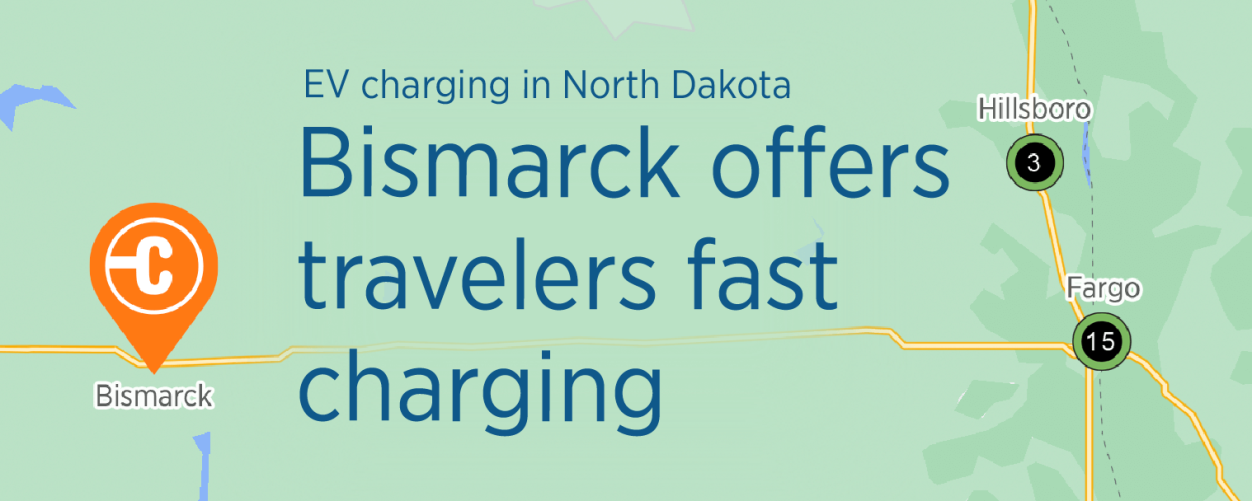
We’re about to wrap up our road trip through North Dakota, but we’d be remiss if we didn’t pay a visit to the state capital, Bismarck, to discover how that city spent its portion of the $2.7 billion in Schedule D (Volkswagen Environmental Mitigation Trust) funds dedicated to investments in emissions reduction projects across the U.S. This city used its share to purchase a pair of dual-port ChargePoint Express Plus DC fast charging stations — the first of their kind there.
“I was tasked as the lead to apply for settlement funding that was administrated from the North Dakota Department of Environmental Quality (DEQ),” says Will Hutchings, a planner with the city’s Community Development Department. “After the award, I continued my role as the lead project manager and coordinated the purchase and installation of the charging stations.”

Stop, stay, spend
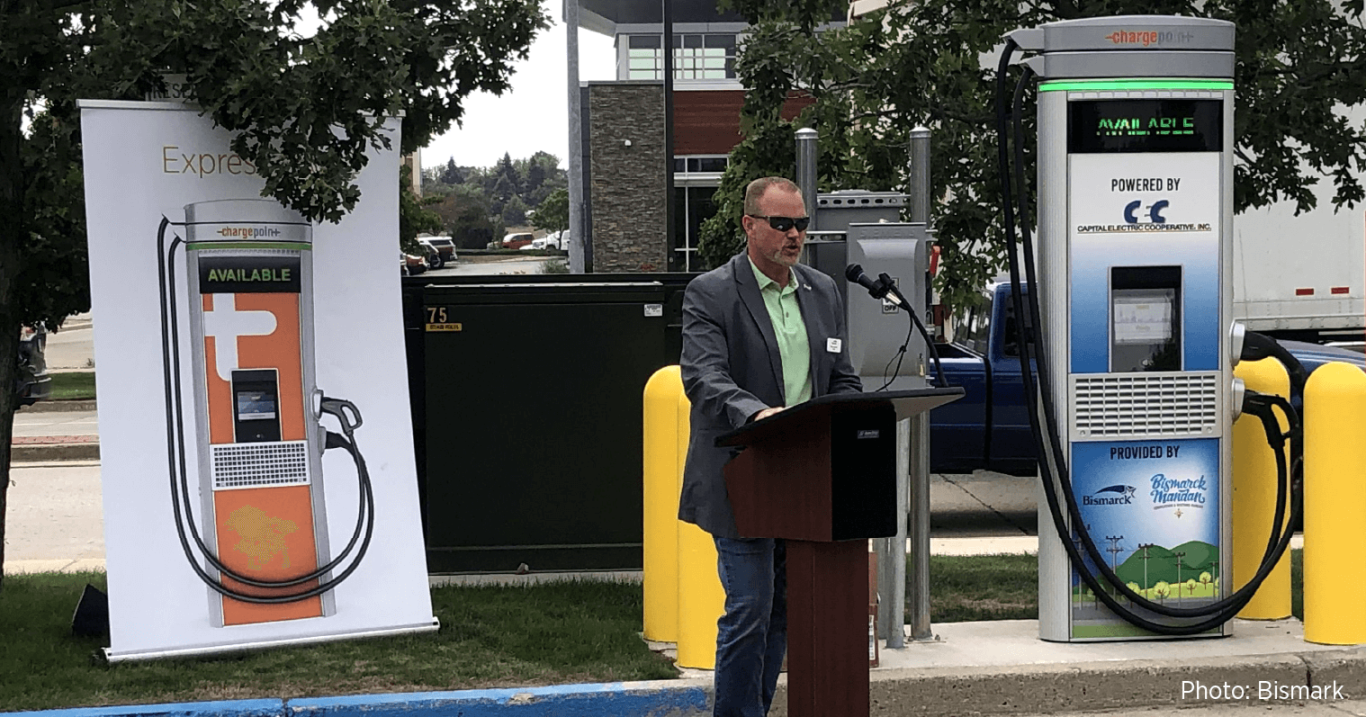
The stations, located at the Bismarck-Mandan Convention and Visitors Bureau (CVB) and the Bismarck Airport, were recently unveiled in a public ribbon-cutting ceremony at which Mayor Steve Bakken declared, "We now have laid the groundwork for EV charging to be a connecting point across the region, ensuring that EV travel is possible across the entire state of North Dakota."
Echoing what we’ve heard across the state, Hutchings says he expects EV charging to attract both visitors and economic opportunity to the city. “With the CVB location, we were looking at not only how we can bring some of those travelers off the interstate, but how we can capitalize on getting them to stimulate the economy by shopping locally or taking advantage of some of our regional attractions. We want them to be able to experience all the great things our community has to offer.”
One thing that was great about ChargePoint is that everything was all in one package and available for us to just plug and play with the help of a qualified installer. — Will Hutchings, Planner, Bismarck Community Development Department
Endless opportunities ahead
With regards to the community, Hutchings says locals are as excited about the opportunities the charging stations will bring to Bismarck as EV drivers are. “North Dakotans are a very hardy people,” he says, citing the state’s long winters. “Bismarck residents are innovative and open to technological advancements. They’re not into shutting down ideas, and so there’s been nothing but support that I’ve heard and seen from people in the community. Providing adequate infrastructure for EV drivers to travel across the state is affording possibilities for a lot of people.”
Why ChargePoint?
Hutchings says the city considered several different charging networks before ultimately deciding to go with ChargePoint. “First and foremost, I knew that looking into all the different manufacturers and the variety of services they offered was going to be critical for a successful outcome. What I found with a lot of them reminded me of the early 2000s when you’d get a kit of parts to build your own computer,” he says. “You'd buy your own motherboard. You’d buy your own sound card, and you’d get the case and you’d put it all together. But if you didn't know what you were doing when it came to setting up the computer, you were on your own. One thing that was great about ChargePoint is that everything was all in one package and available for us to just plug and play with the help of a qualified installer.”
And there you have it — three cities in North Dakota that are making a difference for their state, their citizens and the planet. We’re grateful to all the people who participated in bringing this series to life and who took the time to talk to us. Thank you.
Ready to invest in e-mobility? ChargePoint, together with Green Way Energy can help you find incentives in your area.
In this area you will find news releases and articles that are relevant to EV charging; tech nical documents and legislative issues. Click on each sub page for news.
We need your consent to load the translations
We use a third-party service to translate the website content that may collect data about your activity. Please review the details in the privacy policy and accept the service to view the translations.